Research/Technical Note | | Peer-Reviewed

Laboratory Preparation of Eisenia Fetida-Based Peptone as a Nutrient Source for Vaccine Manufacture

Received: 17 October 2025     Accepted: 27 October 2025     Published: 19 December 2025
Views:       Downloads:
Abstract

The most basic application of protein hydrolysis is to provide nitrogen for bacterial culture media. Given that approximately 200 million doses of Clostridium bacterium vaccines are consumed annually in Iran, and 16 tons of hydrolyzed protein [peptone] are required to produce these doses of vaccines. Currently, this need is met through imports, so it is essential to obtain the technical knowledge to produce peptone from various inexpensive sources in the country. Considering the development of vermicompost worm breeding farms, their cheapness, availability, and high protein content, protein hydrolysis of this animal was performed. Worm samples were purchased from farms around Mashhad. To empty the digestive system of the worms, they were placed in a container with clean water and sand for 20 hours. Then, homogenizing them in water for 30 minutes provided a homogeneous and uniform suspension. Following this, fat was removed from the protein tissue with chloroform for two 30-minute periods at 25°C and 60°C. Protein hydrolysis was performed using the vapor phase of six-normal hydrochloric acid at 110°C for 20 hours. Complete drying of the sample was performed for 3 hours under vacuum conditions with a single pressure at 70°C. In this study, three grams of peptone were produced from an initial amount of 10 grams of vermicompost worms. This amount of hydrolyzed protein produced was equal to 30% of the initial weight of the worms.

Published in American Journal of Biomedical and Life Sciences (Volume 13, Issue 6)
DOI 10.11648/j.ajbls.20251306.14
Page(s) 142-147
Creative Commons

This is an Open Access article, distributed under the terms of the Creative Commons Attribution 4.0 International License (http://creativecommons.org/licenses/by/4.0/), which permits unrestricted use, distribution and reproduction in any medium or format, provided the original work is properly cited.

Copyright

Copyright © The Author(s), 2025. Published by Science Publishing Group

Keywords

Peptone Production, Amino Acids, Protein Sources, Acid Hydrolysis, Worm Protein

1. Introduction
1.1. Needs to Prepare Hydrolyzed Protein and Peptone
Developing countries often have serious problems with food supply in terms of accessing and consuming proteins that have higher nutritional value than other nutrients. Unfortunately, the diet of millions of people in countries is more dependent on using carbohydrates to provide energy for their bodies. However, the carbohydrate diet often lacks amino acids. Therefore, it is limited by not having essential amino acids. Accordingly, efforts have been made to obtain protein from unconventional sources that can be used in various food products for human consumption . The most basic application of hydrolyzed protein in biotechnology is providing a source of nitrogen for bacterial culture environments on an industrial and specialized scale. It is also a source of nitrogen for the cultivation of microbial, plant, animal, and insect cells on a laboratory and industrial scale . Developing countries have serious problems in terms of access to and consumption of proteins with high nutritional value, so that, unfortunately, the diet of millions of people in these countries is more dependent on the use of carbohydrates as energy sources, but this diet lacks essential amino acids and is somewhat limited in this regard. Peptones, as a main ingredient of media, provide carbon, nitrogen, minerals, and growth factors needed to support the metabolic requirements of microbial and mammalian cells. Therefore, they cause cell proliferation and production. Protein sources that are commonly used as raw material in peptone production include meat, gelatin, soy, casein, and whey [milk proteins] .
1.2. History of Protein Hydrolysis
The first acid hydrolysis of protein for amino acid analysis was reported in the early 1950s . Although the first acid hydrolysis of protein was performed in 1820, it took several decades for this process to be commercialized and is still ongoing . Much research has been done in the field of protein hydrolysis from various sources, including the analysis of protein from vermicompost worms [California red worms] for human and animal food . Also, meal prepared from vermicompost worms has been used as an economic source for the production of lactic acid under fermentation conditions due to its high nitrogen and protein content . Approximately 100,000 tons of marine fish are harvested annually, including a large number of small fish and by-products that do not meet the quality criteria required for food use. Therefore, the hydrolysis of fish proteins is a suitable strategy to provide economic benefits from fish processing wastes into high-quality and high-value products . The tuna processing industry has 60% of waste by-products, including heads, Bones, and gills, dark meat, and blood, which are used to produce hydrolyzed protein. In addition, the blood of chicken, pig, deer, sheep, and cow has also been used for this purpose . Today, hydrolyzed fish protein has attracted the attention of many food biotechnology experts due to its appropriate number of amino acids and bioactive peptides that have antioxidant, antihypertensive, immune system-regulating, and antimicrobial properties. Also, this hydrolyzed protein is water-soluble and does not coagulate in hot water . The production of hydrolyzed protein from Nile tilapia by-products and the evaluation of the effects of different hydrolysis times on the antioxidant activity of hydrolyzed protein have been carried out . In addition, in Iran, intestinal waste and viscera of rainbow trout and chicken have been subjected to hydrolysis with alkalase . A research project titled "Preparation of peptone from soy protein for enterotoxemia vaccine culture medium" was conducted in 1997 at the Razi Vaccine and Serum Research Institute. In this research, the hydrolysis of soy proteins with trypsin enzyme was reported .
1.3. The Need for Peptone Production in Iran
Relative evaluation of given that approximately 200 million doses of Clostridium bacterium vaccines are used annually in the country, and this amount of the country's need for enterotoxemia vaccine is produced and supplied by the Razi Institute, and on the other hand, the production of this amount of vaccine requires the availability of 16 tons of hydrolyzed protein [peptone], which is currently supplied through imports, it is necessary to obtain technical knowledge for the production of hydrolyzed protein [peptone] from various sources in the country. On the other hand, given that vermicompost production farms using Eisenia fetida worms are increasingly developing and expanding, and also because the amount of protein in this organism is very high, so that its protein content is determined to be 61.85%, fat 11.13%, and ash 7.8% in one gram of dry weight . This research was carried out as a priority to obtain technical knowledge for the production of hydrolyzed protein from one of the cheap and accessible sources in the country, so that it can be used in future vision: To meet the domestic consumption needs of this product in vaccine production, it increased employment opportunities and the development of fertilizer and worm production farms in the country.
1.4. Protein Hydrolysis Reaction Chemistry
In the protein hydrolysis reaction, what biologists call a peptide bond, chemists call an amide bond. In an amide like ethanamide, the carbon-nitrogen bond in the amide group is broken, forming a carboxylic acid, as shown in equation (1).
CH3+H2O+H+CH3COOH+NH4(1)
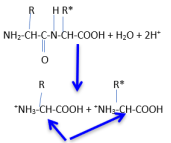
If the same reaction were to occur on a peptide containing two amino acids [Figure 1]
Notice the positive ions formed from the amino acids.

Download: Download full-size image

Figure 1. Reaction were to occur on a peptide containing two amino acids.
The hydrogen ion is produced by the two positive ions of the amino acid. In protein hydrolysis, compared to the ammonium ion, the reaction of the NH2 group with the acid requires many hydrogen ions to occur in the hydrolysis of all peptide bonds . Acid hydrolysis of proteins is a laborious process that is usually carried out at relatively high temperatures. In this process, several amino acids, including tryptophan, are completely digested by acid, while cysteine, serine, and threonine are partially broken down . Asparagine and glutamine are converted to their acid forms .
1.5. Hydrolysis Processes
After hydrolysis, the "crude hydrolyzed product" may undergo further processing. Post-hydrolysis processes include heat inactivation, ultrafiltration, hydrolysis by proteases, and specific enzymes. Table 1 describes the main post-hydrolysis processes and their performance .
Table 1. Main processes after hydrolysis.

Process

Performance result

Heating

Inactivation of proteolytic enzymes

Ultrafiltration

Removal of high molecular weight peptides and proteins

Use of specific enzymes

Reduction of specific amino acids

Hydrolysis by exoprotease

Further hydrolysis and reduction of bitterness

Use of activated carbon

Reduction of bitterness

Absorption chromatography

Reduction of aromatic amino acids

1.6. Peptone Production
Hydrolyzed protein peptone is also called peptone. Peptone is the result of the hydrolysis of protein materials. Peptones provide carbon, nitrogen, minerals, and growth factors needed to support the metabolic processes of microbial and mammalian cells, thereby promoting cell proliferation and production. In addition, peptones have been used as serum substitutes and environmental supplements in mammalian cell culture media. Protein sources commonly used as raw materials in peptone production include meat, casein and whey [milk proteins], gelatin, and soy . Eisenia fetida is classified in the phylum: class: Oligochaeta, order: Haplotaxia, and the family: Lumbricidae . In addition, the flour prepared from vermicomposting worms has been used as an economic source for the production of lactic acid in fermentation conditions due to their high amount of nitrogen and protein . In Iran, intestinal wastes and viscera of rainbow salmon and chicken have been hydrolyzed with alkalase .
2. Materials and Methods
2.1. Preparation of Worm Samples
The worm samples used in this study were purchased from a farm around Mashhad and transferred live to the research department of the Razi Institute, Mashhad branch, in a natural substrate containing cow manure. To conduct the study, the samples were separated from the natural breeding substrate and placed in a container of water containing clean sieved sand for 24 hours to remove digestive system waste. The volume of clean sieved sand was two-thirds of the volume of the storage container. After this period, the worms were emptied from the container and weighed under dry conditions with a Sartorius laboratory balance.
2.2. Homogenization
In the next step, the worms were homogenized in water for 30 minutes with a Homogenizer [Lab Ohm Technic], and a homogeneous and uniform suspension was prepared from them. Then, the homogenized contents were washed with municipal water for three repetitions.
2.3. Defatting
To defat, the remaining tissue contents of the worms were transferred to a graduated cylinder, and half the volume of Merck chloroform solution was added to them. Then, the tissue solution samples containing chloroform were shaken for 30 minutes under laboratory temperature conditions with a Magnetic hot plate [Yellow Mag HS]. In the next step, they were placed under the Jahan Danesh laboratory hood for 30 minutes at 60 degrees Celsius while the samples were shaken simultaneously. After that, the tissue samples were centrifuged for 30 minutes at 3000 RPMI. The supernatant solution included the water layer, and the lower solution included the chloroform remaining from them. They were placed at 70°C for five hours. At the end of this stage, the defatted protein was weighed.
2.4. Acid Hydrolysis of Protein
For acid hydrolysis of protein, the defatted tissue residue was transferred to an open test tube. Then, Merck's six normal hydrochloric acid diluted with water to a fourfold [volume/weight] ratio was poured into a screw-top Pyrex glass, and the test tube containing the tissue residue was placed in it . For acid hydrolysis, the tissue samples were exposed to flame heat for 10 hours at 110°C in a closed container .
2.5. Drying
Complete drying of the hydrolyzed protein sample was carried out for 3 hours under vacuum conditions with a Millipore device at a pressure of one bar at a temperature of 70°C, placed on a hot plate. Finally, after drying the hydrolyzed protein produced, it was ground, and the uniform protein powder produced was weighed. These experiments were repeated three times under the same conditions.
2.6. Ethics
All the ethical standards were approved by the ethics committee of the Razi Vaccine and Serum Research Institute, Mashhad Branch, Iran.
3. Results
The results showed that the best conditions for transferring the worm samples alive are the environment in which they previously lived. Also, keeping the worm samples in washed and sieved sand and water for 20 hours resulted in the complete removal of the waste residues from the worms. Washing the waste materials from the worms is important in accessing clean tissue residues for entering the protein production stages. The results showed that preparing a homogenized solution from tissue residues was effective in advancing the next stages. The results indicated that the chloroform reaction for defatting in two 30-minute periods at 25°C and 60°C temperatures separated the fat from the protein tissue. On the other hand, heating the sample in dry conditions at 70°C caused the evaporation [boiling point of chloroform 61.5°C] of the chloroform residue from the sample. The results showed that protein hydrolysis under hydrogen ion vapor conditions occurred in a state where contact was maintained. The direct reaction between acid and protein was not completely carried out, so that, in total, on average, from 12 gr of cream after washing, 3 gr of powdered peptone was produced. The details of the quantitative changes in the process of producing hydrolyzed protein are described in Table 2.
Table 2. Details of quantitative changes in the hydrolyzed protein production process.

Process steps

Average weight in gr after three repetitions

Weight after removal from the bed stage

10

Wet weight after exiting the digestive waste excretion stage

12.5

Wet weight after the defatting stage

8.4

Dry weight after the defatting stage

5.2

Wet weight after the hydrolysis stage

5.6

Final weight after drying stage

3

4. Discussion
This research has investigated the possibility of producing peptone from a protein source such as cream in the form of a laboratory research study. Undoubtedly, the higher the protein source used for peptone production, the higher the quality of the peptone, and the easier and less expensive it will be to produce pure peptone from it. What is clear and certain, and in comparison, with cream peptone and soybean, we can state that the amount of protein in soybean is less than that of worm . Therefore, apart from comparing other aspects regarding the amount of protein, choosing worm as a protein source is preferable to soy. In addition to this issue, the issue of extracting protein from animal and plant sources has major differences, including the fact that plant sources, such as soy, generally contain large amounts of oil and carbohydrates in addition to protein. In order to produce peptone from them, these two sources must first be separated from the protein tissue, and then peptone must be produced from defatted soy powder. Separating these two requires a lot of cost and consumables. Therefore, performing these two processes before producing peptone increases the costs associated with the process. Although soy production is cheaper than cream, in the process of producing peptone by hydrolysis, the cost of producing peptone from soy is higher compared to animal and cream protein sources. The results obtained from the research project titled Preparation of peptone from soy protein at the Razi Institute have shown that compared to meat peptone, bacterial growth in both protein sources was the same, but in the study Toxins of different types of Clostridium perfringens bacteria The exotoxin secretion from cultivation in soy medium was lower compared to meat peptone, which is considered to be due to the poor amino acid richness of soy protein. In other words, this issue is due to the fact that the ratio of amino acids necessary for stimulating, making, and secreting exotoxin in soy is not appropriate . The rapid hydrolysis method, which has been used mostly for small-volume samples, involves placing proteins in an atmosphere of hydrogen ions for hydrolysis . It is much more efficient compared to other hydrolysis methods, such as immersion hydrolysis in acid and alkali and enzymatic hydrolysis, because in practice, there is no direct contact between the acid and the protein, so in this case, there is no need to separate the acid in the later stages. Chemical hydrolysis is often difficult to control, and the quality of the product produced from it is reduced . So that this process destroys the amino acid formula . Most often, protein hydrolysis produces two fractions: the first fraction contains a large number of amino acids, and the second fraction contains bioactive peptides containing amino acids that have not been hydrolyzed but are activated by exposure to proteolytic enzymes . The disadvantage of the acid hydrolysis method is that it destroys the amino acid tryptophan . In addition, it partially destroys the amino acid methionine. On the other hand, under this hydrolysis method, the amino acid glutamine is converted to glutarate, and the amino acid asparagine is converted to aspartate . Various methods have been reported to increase the recycling of tryptophan after acid hydrolysis, including adding thiols and tryptamine to recycle tryptophan, or adding pyridineborane before hydrolysis to reduce tryptophan to dihydrotryptophan, or using p-toluensulfonic acid to recycle tryptophan. So far, no protein hydrolysis method has been able to make 100% of the amino acids available . Without a doubt, more and more complete research studies should be conducted before the industrial process of preparing peptone from vermicompost worms for use in the vaccine production process can be achieved. Acid hydrolysis is one of the most important techniques in breaking peptide bonds, and therefore, the use of the vapor phase of six normal hydrochloric acids at a temperature of 110°C has been very effective for the protein of vermicompost worms. In this process, 30% of the initial weight of the worms was produced as hydrolyzed protein [peptone].
5. Conclusion
Acid hydrolysis is one of the most important techniques in breaking peptide bonds, and therefore, the use of the vapor phase of six normal hydrochloric acids at a temperature of 110 °C has been very effective for the protein of vermicompost worms. In this process, 30% of the initial weight of the worms was produced as hydrolyzed protein [peptone].
Acknowledgments
I would like to thank Dr. Hamidar Reza Farzin, the esteemed director of the Razi Institute, Northeast Branch, for supporting this research.
Author Contributions
Hossein Noruzy Moghadam is the sole author. The author read and approved the final manuscript.
Funding
This study was supported by Razi Vaccine and Serum Research Institute, Mashhad Branch, Iran.
Conflicts of Interest
The author declares that they have no conflict of interest.
References
[1] Medina A, Cova J, Vielma R, Pujic P, Carlos M, Torres J. Immunological and chemical analysis of proteins from Eisenia fetida earthworm. Food and Agricultural Immunology. 2003; 15(3-4): 255-63.
[2] Pasupuleti VK, Braun S. State of the art manufacturing of protein hydrolysates. Protein hydrolysates in biotechnology. 2010: 11-32.
[3] Noruzy Mogadam H, Banaei A. Production of hydrolyzed protein from vermicompost worms Eisenia foetida for use in vaccine production process. Veterinary Research & Biological Products. 2022; 35(2): 88-94.
[4] Mustățea G, Ungureanu EL, Iorga E. Protein acidic hydrolysis for amino acids analysis in food-progress over time: a short review.
[5] Hou Y, Wu Z, Dai Z, Wang G, Wu G. Protein hydrolysates in animal nutrition: Industrial production, bioactive peptides, and functional significance. Bioactive Peptides from Food. 2022: 209-32.
[6] Cock LS, Guerrero CAR, Restrepo MAR. The use of earthworm flour for lactic acid biomass production. African Journal of Biotechnology. 2013; 12(40).
[7] Wisuthiphaet N, Kongruang S, Chamcheun C. Production of fish protein hydrolysates by acid and enzymatic hydrolysis. Journal of Medical and Bioengineering. 2015; 4(6).
[8] Mongkonkamthorn N, Malila Y, Yarnpakdee S, Makkhun S, Regenstein JM, Wangtueai S. Production of protein hydrolysate containing antioxidant and angiotensin-I-converting enzyme [ACE] inhibitory activities from tuna (Katsuwonus pelamis) blood. Processes. 2020; 8(11): 1518.
[9] Saputra D, Nurhayati T. Production of fish hydrolysates protein from waste of fish carp [Cyprinus carpio] by enzymatic hydrolysis. ComTech: Computer, Mathematics and Engineering Applications. 2016; 7(1): 11-8.
[10] Bernardi DM, PARIS LDd, Dieterich F, Boscolo WR, Sary C, Signor A, et al. Production of hydrolysate from processed Nile tilapia [Oreochromis niloticus] residues and assessment of its antioxidant activity. Food Science and Technology. 2016; 36: 709-16.
[11] Taheri A, Anvar S, Ahari H, Fogliano V. Comparison the functional properties of protein Hydrolysates from poultry byproducts and rainbow trout. Iranian journal of fisheries sciences. 2013; 12(1): 154-69.
[12] Gahadkchee H. Preparation of pepton soya protein, using in vaccine media. Final Report Res Plan. 1997.[In persion]
[13] Clark J Hydrolysis Hydrolysis of Proteins.
[14] Moreno-Hernandez JM, Benítez-García I, Mazorra-Manzano MA, Ramírez-Suarez JC, Sanchez E. Strategies for production, characterization and application of protein-based biostimulants in agriculture: A review. Chilean journal of agricultural research. 2020; 80(2): 274-89.
[15] Hydrolysis to Hydrolysate. Becton, Dickinson and Company (2009). Available from:
[16] McCarthy AL, O’Callaghan YC, O’Brien NM. Protein hydrolysates from agricultural crops—bioactivity and potential for functional food development. Agriculture. 2013; 3(1): 112-30.
[17] Al-bahri MB, AL-Naimi SA, Ahammed SH. The optimum conditions for production of soya peptone by acidic hydrolysis of soya proteins. Al-Khwarizmi Engineering Journal. 2009; 5(1): 1-19.
[18] Grieshop CM, Kadzere CT, Clapper GM, Flickinger EA, Bauer LL, Frazier RL, et al. Chemical and nutritional characteristics of United States soybeans and soybean meals. Journal of Agricultural and Food Chemistry. 2003; 51(26): 7684-91.
Cite This Article
  • APA Style

    Moghadam, H. N. (2025). Laboratory Preparation of Eisenia Fetida-Based Peptone as a Nutrient Source for Vaccine Manufacture. American Journal of Biomedical and Life Sciences, 13(6), 142-147. https://doi.org/10.11648/j.ajbls.20251306.14

    Copy | Download

    ACS Style

    Moghadam, H. N. Laboratory Preparation of Eisenia Fetida-Based Peptone as a Nutrient Source for Vaccine Manufacture. Am. J. Biomed. Life Sci. 2025, 13(6), 142-147. doi: 10.11648/j.ajbls.20251306.14

    Copy | Download

    AMA Style

    Moghadam HN. Laboratory Preparation of Eisenia Fetida-Based Peptone as a Nutrient Source for Vaccine Manufacture. Am J Biomed Life Sci. 2025;13(6):142-147. doi: 10.11648/j.ajbls.20251306.14

    Copy | Download

  • @article{10.11648/j.ajbls.20251306.14,
      author = {Hossein Noruzy Moghadam},
      title = {Laboratory Preparation of Eisenia Fetida-Based Peptone as a Nutrient Source for Vaccine Manufacture},
      journal = {American Journal of Biomedical and Life Sciences},
      volume = {13},
      number = {6},
      pages = {142-147},
      doi = {10.11648/j.ajbls.20251306.14},
      url = {https://doi.org/10.11648/j.ajbls.20251306.14},
      eprint = {https://article.sciencepublishinggroup.com/pdf/10.11648.j.ajbls.20251306.14},
      abstract = {The most basic application of protein hydrolysis is to provide nitrogen for bacterial culture media. Given that approximately 200 million doses of Clostridium bacterium vaccines are consumed annually in Iran, and 16 tons of hydrolyzed protein [peptone] are required to produce these doses of vaccines. Currently, this need is met through imports, so it is essential to obtain the technical knowledge to produce peptone from various inexpensive sources in the country. Considering the development of vermicompost worm breeding farms, their cheapness, availability, and high protein content, protein hydrolysis of this animal was performed. Worm samples were purchased from farms around Mashhad. To empty the digestive system of the worms, they were placed in a container with clean water and sand for 20 hours. Then, homogenizing them in water for 30 minutes provided a homogeneous and uniform suspension. Following this, fat was removed from the protein tissue with chloroform for two 30-minute periods at 25°C and 60°C. Protein hydrolysis was performed using the vapor phase of six-normal hydrochloric acid at 110°C for 20 hours. Complete drying of the sample was performed for 3 hours under vacuum conditions with a single pressure at 70°C. In this study, three grams of peptone were produced from an initial amount of 10 grams of vermicompost worms. This amount of hydrolyzed protein produced was equal to 30% of the initial weight of the worms.},
     year = {2025}
    }
    

    Copy | Download

  • TY  - JOUR
    T1  - Laboratory Preparation of Eisenia Fetida-Based Peptone as a Nutrient Source for Vaccine Manufacture
    AU  - Hossein Noruzy Moghadam
    Y1  - 2025/12/19
    PY  - 2025
    N1  - https://doi.org/10.11648/j.ajbls.20251306.14
    DO  - 10.11648/j.ajbls.20251306.14
    T2  - American Journal of Biomedical and Life Sciences
    JF  - American Journal of Biomedical and Life Sciences
    JO  - American Journal of Biomedical and Life Sciences
    SP  - 142
    EP  - 147
    PB  - Science Publishing Group
    SN  - 2330-880X
    UR  - https://doi.org/10.11648/j.ajbls.20251306.14
    AB  - The most basic application of protein hydrolysis is to provide nitrogen for bacterial culture media. Given that approximately 200 million doses of Clostridium bacterium vaccines are consumed annually in Iran, and 16 tons of hydrolyzed protein [peptone] are required to produce these doses of vaccines. Currently, this need is met through imports, so it is essential to obtain the technical knowledge to produce peptone from various inexpensive sources in the country. Considering the development of vermicompost worm breeding farms, their cheapness, availability, and high protein content, protein hydrolysis of this animal was performed. Worm samples were purchased from farms around Mashhad. To empty the digestive system of the worms, they were placed in a container with clean water and sand for 20 hours. Then, homogenizing them in water for 30 minutes provided a homogeneous and uniform suspension. Following this, fat was removed from the protein tissue with chloroform for two 30-minute periods at 25°C and 60°C. Protein hydrolysis was performed using the vapor phase of six-normal hydrochloric acid at 110°C for 20 hours. Complete drying of the sample was performed for 3 hours under vacuum conditions with a single pressure at 70°C. In this study, three grams of peptone were produced from an initial amount of 10 grams of vermicompost worms. This amount of hydrolyzed protein produced was equal to 30% of the initial weight of the worms.
    VL  - 13
    IS  - 6
    ER  - 

    Copy | Download

Author Information
  • Abstract
  • Keywords
  • Document Sections

    1. 1. Introduction
    2. 2. Materials and Methods
    3. 3. Results
    4. 4. Discussion
    5. 5. Conclusion
    Show Full Outline
  • Acknowledgments
  • Author Contributions
  • Funding
  • Conflicts of Interest
  • References
  • Cite This Article
  • Author Information